
How To Build Healthy Habits As Christians

You have probably started with so much motivation to begin living healthy, to exercise daily, eat healthy, and live your best life, only for you to be buried in guilt weeks later for not sticking closely to your routine. Many Christians treat healthy living as a form of perfectionism and self-punishment. Maybe you miss one workout morning or indulge in eating very unhealthy meals that you always crave, and then it begins to look as if you failed both physically and spiritually.
Taking care of your body, mind, and soul shouldn't feel like a burden you have to always carry. There's what we call grace-based wellness. This approach transforms every physical care into a joyful act of worship. It's about choosing a health strategy that shifts from strict rules to embracing faith-based wellness, till you develop healthy habits as a Christian that are rooted in God's love and not on your own performance, because discipline rooted in grace produces freedom and not guilt.
Why Building Healthy Habits Feels Hard for Many Christians

If you happen to find yourself falling short of sticking closely to your fitness routines, it's probably not a lack of willpower but a lack of motivation. Because when shame, body dissatisfaction, or ill health drives your behavior, wellness becomes like a chore instead of a choice that's done out of gratitude. The problem is that most people copy a lot of secular wellness strategies, confusing true Christian self-discipline with rigid, rule-bound legalism, transforming their fitness routines into an extra-biblical law.
Another reason is this: most Christians want to live a flawless, healthy lifestyle, such that once they miss a single workout or overeat at a family dinner, it feels like failure and they suddenly break the cycle of consistency. Here's what you need to know that you can prioritize sustainable healthy habits over temporary, intense bursts of perfection. If we embrace grace over perfection in wellness, we can navigate through life without letting minor stumbles derail us.
How to Build Healthy Habits as a Christian

Start Small with Identity-Focused Christian Habit Formation
In learning how to build healthy habits,as Christians, we can look through behavioral psychology and filter it through a biblical worldview. James Clear, the author of Atomic Habits, talks about the concept of tiny, incremental changes that compound over time. And applying these principles can open an avenue for a Christian habit formation.
For instance, instead of transforming your life overnight, build a new habit over an already existing one. You can also choose to do a quick stretch in the morning or jog immediately after your morning devotion.
These natural adjustments help you to build momentum naturally.
Prioritize Grace Over Perfection

A successful day isn't one where everything went on perfectly as planned. It's a day where you walk with God and make every choice with a heart of gratitude. When your day gets so busy that it disrupts your schedule, lean into grace over perfection. If you miss a day of going to the gym, do not let your fitness routine end there. Identify that your body belongs to God, ask for His grace, and focus on making the next day a nurturing one.
Cultivate Routines That Support Both Spiritual and Physical Health.

It's important that you know that faith-based wellness recognizes that the body and spirit are intertwined and cannot be separated from each other. Therefore to build an integrated lifestyle, you have to choose physical habits that refresh your spirit by:
Taking prayer walks or simply listening to a gospel music, or an audio bible while you exercise in the morning.
Respecting the Sabbath day by setting that day aside for God and permitting your body to rest from the week's stress.
Having a regular sleeping time every day honors your body’s natural biological rhythms. It's a signal that you can actually rest while you can and cast the rest of your activities unto the hands of God.
By constantly doing this, you outrightly protect your spiritual and physical health, creating an authentic Christian healthy lifestyle.
What Does Scripture Say About Wellness and Stewardship?

We are all familiar with the popular body as a temple bible verse. What if we read 1 Corinthians 6:19–20 in its true context, we see something much deeper: "Do you not know that your bodies are temples of the Holy Spirit, who is in you, whom you have received from God? You are not your own; you were bought at a price. Therefore honor God with your bodies.”
This scripture isn't a command for you to achieve perfection, but a reminder for you that your body is valuable to God. It is an act of biblical stewardship of the body that we nurture our health so we can preserve our energy, mental clarity, and physical strength to serve our families, love our neighbors, and fulfill the unique kingdom calling God has placed on our lives.
3 Common Mistakes to Avoid on Your Faith-Based Wellness Journey

Slipping into Legalism in Health and Fitness
It can be quite easy for healthy habits to become our idols, so that we become obsessed with every health routine and so rigid in following every principle, such that when they begin to dominate your thoughts and dictate your mood, you have slipped into a modern form of legalism in health and fitness. If your fitness routine causes you to isolate yourself from fellowship or leaves you trapped in a cycle of constant anxiety, it's time to pause and realign your heart with God's grace.
Ignoring God’s Command for Rest
It's not a new story that God Himself rested on the seventh day after creating the universe. And as Christians living in a world that glorifies constant hustle, we treat sleep as luxury and rest as laziness. But a life without physical recovery is very much unsustainable. Building sustainable, healthy habits is you honoring the natural boundaries of rest that God designed for our well-being.
Allowing Past Food Guilt to Dictate Current Choices
Shame is a poisonous, transient fuel. You are not encouraging yourself toward long-term health when you allow prior eating decisions to cause you regret; rather, you are causing a bodily stress reaction that may impair your metabolism and digestion. Grace-based wellbeing serves as a reminder that God's mercy covers our errors. Your worth today is unaffected by decisions made yesterday.
From Stress to Wholeness Bundle.
Experiencing true transformation, entails that we reframe how we view our wellness routines. And this happens when our daily choices flow from an identity of security rather than a desperate search for worth, that's when the heavy burden of guilt lifts away. Healthy choices stop feeling like a forced punishment and start feeling like a natural expression of worship. With God ever ready to walk the path with you, that's what real wholeness looks like, because He is more interested in your daily faithfulness than your physical perfection.
I created the From Stress to Wholeness Bundle for you.
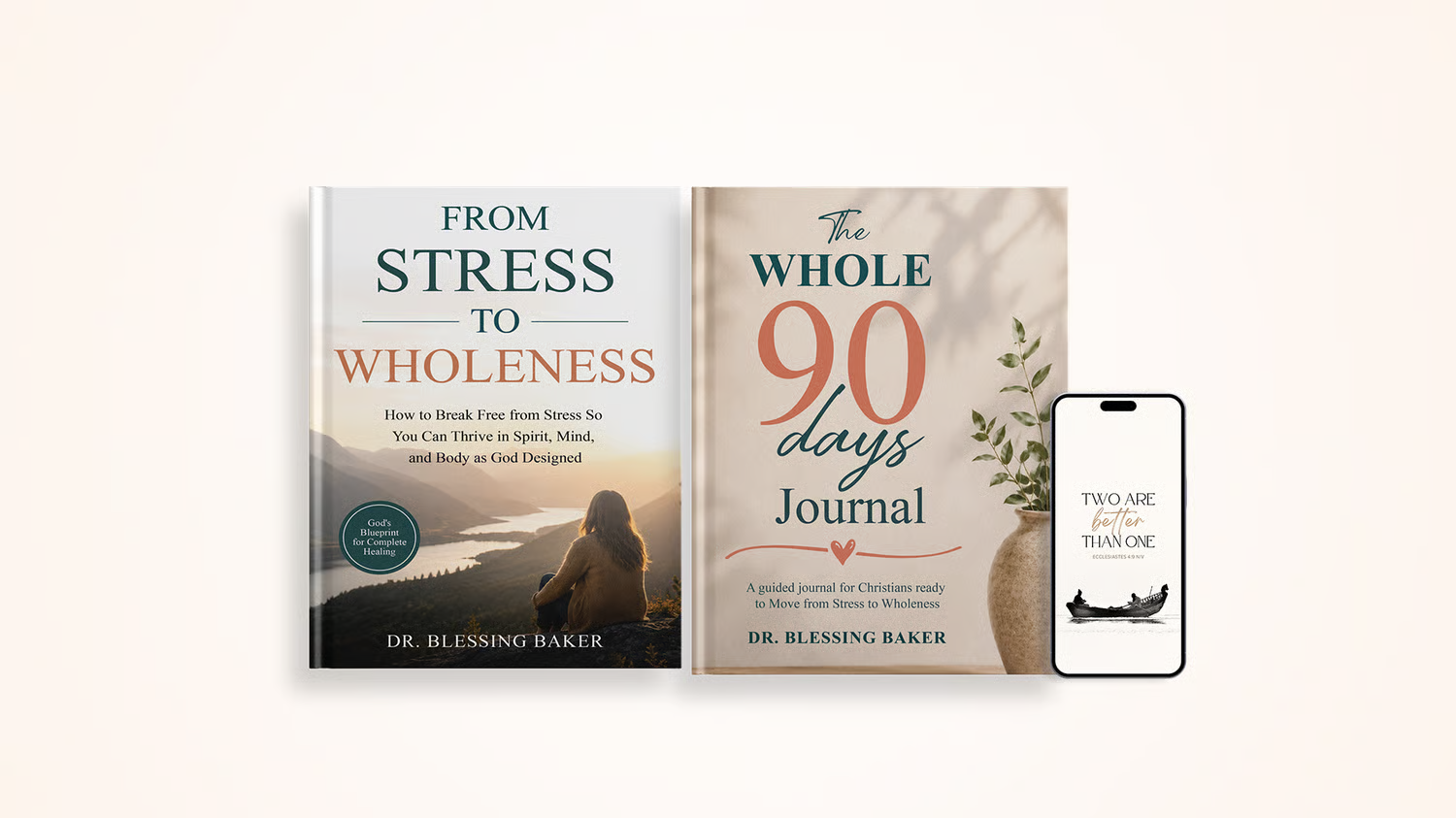
The From Stress to Wholeness book, which gives you a faith-rooted and medically grounded path on how to return to wholeness again.
The Whole 90 Days Journal which will be with you every morning for three months with guided prompts, honest prayers, and daily reflections.
Then a bonus digital reminder of God's promises for your wholeness.
The book of 3 John 1:2 reminds us
“Beloved, I pray that you may prosper in all things and be in health, just as your soul prospers" (NKJV).
Your health and the prosperity of your soul were never meant to be separated. They were always meant to grow together.
This bundle was built for the person who is done starting over and ready to stay.
Get your copy here
Conclusion
Building healthy habits as Christians is a lifelong journey of grace. God Himself does not demand perfection from you, He knows your strength and your capabilities, such that He invites you into faithful stewardship. Today, you can choose to put down the faith-rooted shame, the voice of food guilt, and step forward into a sustainable relationship with your body. Pick just one small, manageable habit to start with this week, and trust the Holy Spirit to guide you, and enjoy the true freedom of biblical stewardship of the body.
Frequently Asked Questions
1. Is focusing on physical fitness and diet considered vanity in the Bible?
Focusing on your health only becomes vanity if your motivation is to earn human approval, chase a worldly aesthetic, or find your identity in your appearance. If your goal is strictly to hit a specific clothing size or look better than everyone else, that is vanity. However, if your motivation is capacity, and that's to serve God better, then that's an act of worship.
2.What does it practically mean to treat your body as a temple?
In the Old Testament, the Temple was the literal dwelling place of God’s presence, and it was treated with immense respect. Under the New Covenant, the Holy Spirit lives inside you (1 Corinthians 6:19). Practically treating your body as a temple means managing it like holy ground, not a dumpster or a slave.And this entails feeding your body with the right meal and resting when your body deserve the rest.
3.How can I overcome emotional eating and food guilt using scripture?
Emotional eating happens when we use food as a psychological coping mechanism to numb stress, loneliness, or anxiety. Food is a wonderful gift from God. When we look to the pantry to do what only the peace of God can do, we end up trapped in food guilt. The book of Romans 8:1 says there is no condemnation for those in Christ Jesus. Therefore use the "Pause and Pour" method. When a emotional craving hits, step away for 10 minutes and literally pour out your stress to God in prayer. If you still eat, drop the guilt instantly, shame only fuels the next emotional binge.
4.What is the difference between secular mindfulness and Christian biblical meditation?
This is a massive point of confusion. Secular mindfulness is rooted in Eastern practices that tell you to empty your mind, detach from reality, and look deep within yourself to find ultimate peace. Christian meditation is the exact opposite: it is about filling your mind with the truth of God and anchoring yourself to His character.
