
Christian Burnout vs. Clinical Depression: How to Tell the Difference

Christian burnout and clinical depression can look alike: constant tiredness, low motivation, a fading sense of joy, but they come from different roots and need different responses.
Christian burnout is emotional exhaustion from prolonged, unmanaged stress or over-serving; it usually eases with real rest, boundaries, and a lighter load.
Clinical depression is a mental health condition rooted in biology, genetics, and environment; it persists regardless of rest and often needs professional treatment.
Burnout is usually tied to a specific season or role (ministry, work, family); depression tends to affect every area of life, including self-worth.
Losing interest in prayer or in reading the Scripture can signal either one, but if it doesn't lift with rest, it may be depression, not a spiritual failing.
If symptoms last more than two weeks, interfere with daily life, or include thoughts of self-harm, seek professional help right away.
Introduction
I was once where you are. I have prayed. I have served in places where I was constantly needed. And have shown up to every meeting, every prayer chain, every Sunday gathering, and somehow, somewhere, it still feels hollow. At some point you will wonder whether you are simply worn out or dealing with something deeper. I want you to know that you are not alone, and you are not lacking in faith. Any lingering fatigue, prayers that feel empty, and a joy that seems to have quietly gone missing can point to burnout, clinical depression, or both at once. Understanding the difference between Christian burnout and clinical depression is the first step toward real relief and toward the kind of help you need, whether it's spiritual or medical, as long as it is actually the help that fits what you're carrying.
Christian Burnout vs. Clinical Depression: A Quick Comparison
Because burnout and depression share similar symptoms like tiredness, low motivation, and difficulty concentrating, it's easy to mistake one for the other. This side-by-side comparison is meant to help you spot the difference at a glance. It's not a diagnostic tool, but a starting point for you to have a more informed conversation when you visit your doctor, therapist, or pastor.
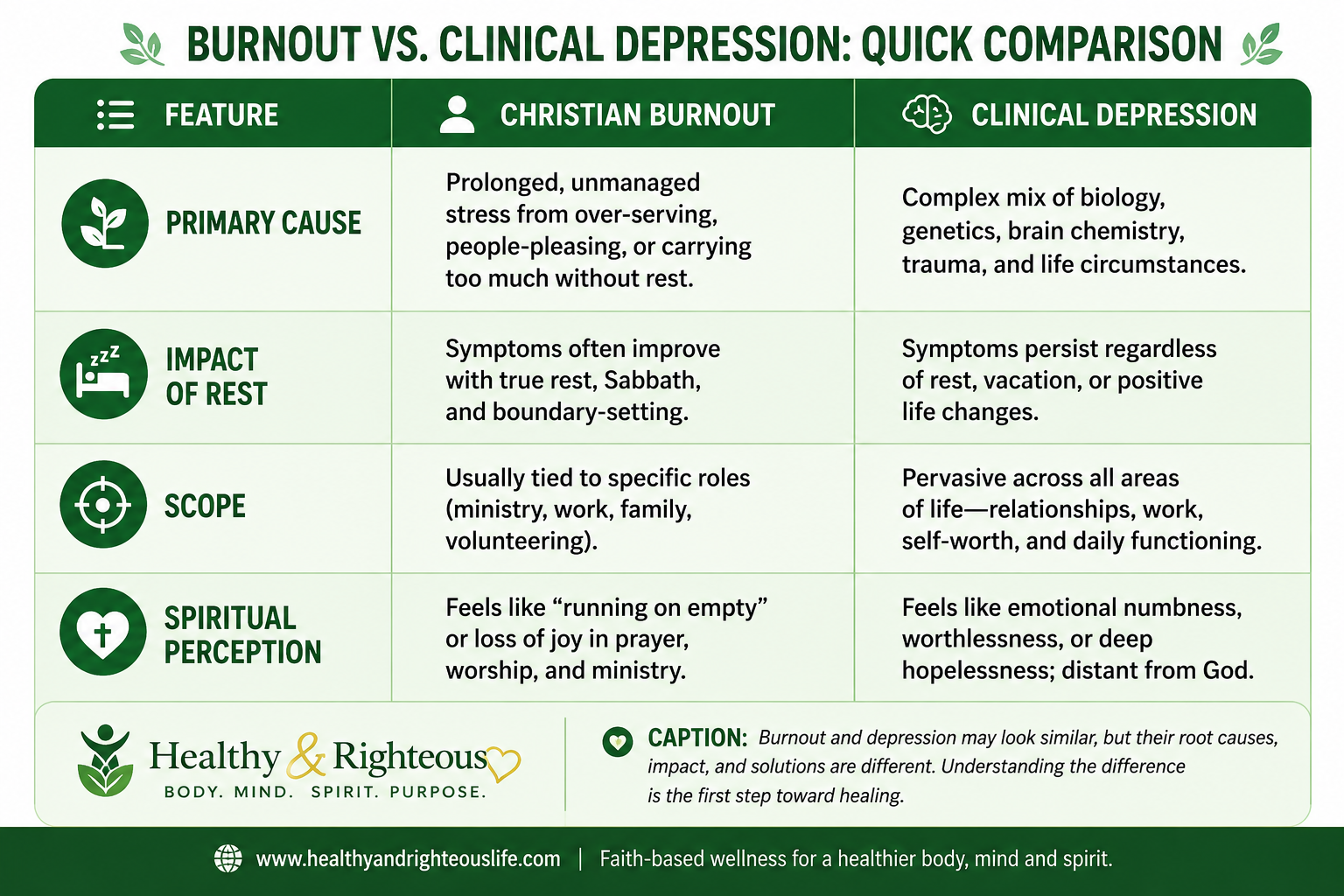
If several of these rows describe a season that has lasted for weeks rather than days, or that rest hasn't been able to solve, that's a signal this may be more than burnout
and you will want to meet a health professional.
If you want to book a consultation call with a licensed medical doctor who knows and understands what you feel, both physically and spiritually, as a Christian should.
Book your consultation here.
(Attach consultation link)
What Does Christian Burnout Actually Look Like?

A few years ago, I was the welfare leader of my class in medical school. I was always available and always serving, ensuring that nobody was left out of being cared for. But I didn't know I was also losing my own self.
Christian burnout doesn't just appear, it usually builds slowly, through over-serving and ignoring your own limits until your emotional tank finally runs dry. It shows up in ministry leaders who can't remember when last they decided to rest, in small-group hosts like myself who feel guilty saying no, in believers who measure their worth by how much they give. This is emotional exhaustion in ministry and oftentimes it starts with good intentions.
And one of the clearest signs of Christian burnout symptoms you should look out for is that spiritual disciplines start to feel like obligations instead of gifts you should cherish. Prayer becomes another item on a to-do list that becomes hard to tick. Fellowship starts to drain you rather than fill you. This loss of joy in prayer is not a sign that your faith is failing , it's a sign that you're depleted.
Even the prophet Elijah, after a great spiritual victory, collapsed under a broom tree and asked God to let him die (1 Kings 19). God's first response wasn't a sermon. It was the simplest thing: sleep and food. Sometimes the most spiritual thing you can do is to rest.
What Are the Key Differences Between Spiritual Burnout and Depression?

Once you understand what each condition looks like, these four distinctions can help clarify spiritual burnout vs depression:
Contextual vs. pervasive. Burnout is usually tied to specific stressors, a demanding ministry season, a difficult job, or an overcommitted schedule. Depression tends to color everything, regardless of circumstance.
Resource depletion vs. mood disorder. Think of burnout as an empty tank that refills with rest and boundaries. Depression is less like an empty tank and more like a filter that changes how everything looks and feels, rest included.
Recovery mechanisms. This is one of the clearest burnout vs depression symptoms to watch for: burnout typically responds to rest, delegation, and boundaries. Depression often requires therapy, medical treatment, or both willpower and rest alone rarely resolve it.
Co-occurrence. These two aren't mutually exclusive. Severe, unaddressed burnout can tip into clinical depression over time, which is exactly why catching it early matters for depression and Christian faith alike.
What Are the Signs of Depression in Christians? When It's More Than Fatigue

Some red flags point past ordinary tiredness and toward something clinical: it could be a persistent emptiness that doesn't get filled, changes in appetite or sleep, feelings of worthlessness, or thoughts of self-harm.
One of the more painful signs of depression in Christians is spiritual apathy, a sudden lack of interest in scripture, worship, or prayer. This is where spiritual apathy vs depression needs careful handling: losing the desire to read your Bible during a depressive episode is a medical symptom, not a spiritual failing. Depression can flatten your capacity to feel anything, including the things you love most, and that is not evidence of weak faith.
If thoughts of self-harm or suicide are part of what you're experiencing, please treat that as urgent. Reach out to a mental health professional or a crisis line right away, you'll find contact information later in this blog.
What Are the Physical Symptoms of Spiritual Burnout?

Burnout rarely stays "just emotional." The physical symptoms of spiritual burnout often show up as headaches, chronic muscle tension, digestive issues, and disrupted sleep. Your body keeps a record of what your calendar refuses to acknowledge.
It can be tempting to spiritualize these signals, to pray away a tension headache instead of asking what this symptom is telling you about your health. But spiritual exhaustion and physical exhaustion are deeply connected. Persistent physical symptoms, especially alongside emotional fatigue, are your body signaling that a boundary has been crossed and they deserve attention, not just another round of prayers.
What Is a Biblical Response to Burnout?

When I began to seek answers about how to steward my body and soul for Christ the right way, I discovered that
a biblical response to burnout starts by reframing rest as obedience, not laziness. God built rhythms of rest into creation itself, and honoring your limits isn't a lack of devotion, it's a form of trust.
Part of that biblical response also means you leave the well-meaning but harmful advice to "just pray harder." Faith burnout doesn't heal through sheer spiritual effort anymore, just like a broken leg doesn't heal through positive thinking only. God designed human bodies with real limits, and He also provided real resources, including doctors, therapists, and counselors as part of His care for us, not a substitute for it.
When Should Christians Seek Therapy or Professional Care?

Dr Baker, should I trust God or take the medication?
A lot of times I get this question from Christians, and my answer is not either/or; it's both/and. Because God created doctors and designed medicine for your well-being. Accepting therapy is not a sign of spiritual failure. It is wisdom. And knowing when to seek therapy comes down to a few clear triggers: symptoms that interfere with your daily responsibilities, sadness or numbness that lasts longer than two weeks, or any thoughts of self-harm.
If you are having thoughts of suicide or self-harm, please reach out now:
In Nigeria: SURPIN's 24-hour helpline — 0806 210 6493 or 0809 210 6493 — or the national emergency line, 112
In the U.S.: Call or text 988 (Suicide & Crisis Lifeline)
Anywhere else: Search findahelpline.com for a verified crisis line in your country, or go to your nearest emergency room
Taking Your Next Step Toward Healing
Whether you're facing burnout, clinical depression, or both, the goal is never to put it in your face that you have either or both of them , it's to help you choose the path that actually leads to recovery. And that path usually includes rest, honest community engagement, and, where needed, professional care. You don't have to earn your way out of exhaustion. You just have to take the next right step.
I created a bundle for you that has a book called From Stress To Wholeness, together with other resources that will teach you what other self-help books wouldn't. It was a resource I wished I had when I was seeking answers on how to manage stress, burnout, and mental exhaustion as a Christian should.
In this bundle, you will get a book that gives you an understanding of what stress is. A journal that gives you the daily practice. And screensavers that will keep the truth in front of you hundreds of times a day when the journal is closed.
You don't have to do this alone, the WHOLE bundle was created just for you.

You can get your copy here
Frequently Asked Questions
What is the difference between Christian burnout and clinical depression?
Christian burnout is emotional depletion caused by prolonged stress, over-serving, or unmanaged responsibilities, and it typically eases with real rest and boundaries. Clinical depression is rooted in a complex mix of biology, genetics, and environment, and it tends to persist even when you rest. Burnout is usually tied to specific roles or seasons; depression tends to affect every part of life.
What are the symptoms of Christian burnout?
Common Christian burnout symptoms include emotional exhaustion, dreading responsibilities you once enjoyed, irritability, trouble concentrating, and prayer or fellowship starting to feel like an obligation rather than a source of life. Physical signs like headaches, muscle tension, and disrupted sleep often show up alongside the emotional ones.
Can spiritual burnout turn into depression?
Yes. Left unaddressed, severe burnout can develop into clinical depression over time. This is why catching burnout early through rest, delegation, and honest boundaries matters, and why symptoms that don't improve with rest deserve a closer look from a professional.
Is losing interest in prayer a sign of burnout or depression?
It can be either. In burnout, spiritual disciplines often feel heavy or obligatory, but joy tends to return with rest. In depression, this loss of interest, sometimes called spiritual apathy, is usually more pervasive and doesn't lift with rest alone. Either way, it's a medical or emotional symptom, not a spiritual failing.
What are the physical symptoms of spiritual burnout?
Spiritual burnout often shows up physically as headaches, chronic muscle tension, digestive issues, fatigue, and trouble sleeping. These symptoms are your body's way of signaling that your pace of life or ministry load has crossed a sustainable limit.
Is it a sin to feel depressed as a Christian?
No. Depression is a medical and emotional condition, not a moral or spiritual failure. Scripture includes figures like Elijah and David who experienced despair and exhaustion, and God met them with compassion, rest, and provision not condemnation.
When should a Christian seek therapy?
Consider professional therapy if symptoms interfere with your daily responsibilities, last longer than two weeks, or include thoughts of self-harm. Therapy works well alongside, not instead of, a person's faith, and seeking it is a wise, practical step, not a sign of weak faith.
How can Christians recover from burnout without losing their faith?
Recovery usually involves reframing rest as an act of obedience, setting honest boundaries around ministry and service, leaning on trusted community, and seeking professional support when needed. None of this diminishes faith , it reflects the same God-given wisdom that built rest into creation itself.
