
Setting Healthy Boundaries as a Christian Without Guilt

A typical christian life can look like this; you had told someone that you would help with the program. Then you said yes to the extra Sunday duty, the 10 p.m. phone call, the family request that arrived with a side of guilt, and the friend who needs "just a quick favour" again from you. So you become tired. You are quietly resentful. And you feel guilty about the resentment, because surely Jesus would have said yes to all of it right?
If that sounds familiar, you are in the right place. Many believers quietly equate saying no with failing to love.
I want you to understand that setting healthy boundaries as a Christian is not a lack of love; it is the stewardship of your time, heart, and emotional capacity so you can serve God and others sustainably without resentment.
The real struggle is rarely that we do not understand boundaries. It is that guilt, the fear of disappointing people, and a few misunderstood ideas about forgiveness and sacrifice make "no" feel almost sinful. Here is the good news: loving people will never require you to accept every demand.
In this blog , we will look at what the Bible says about boundaries, how Jesus modelled them, how to set boundaries as a Christian step by step (with word-for-word scripts), and how to apply them in your family, and friendships.
What Does the Bible Say About Boundaries?
Are Boundaries Biblical? What The Scripture Actually Teaches
The word "boundary" in the modern, relational sense does not appear in your Bible. But the principles behind it are woven in the Scripture through: ownership, limits, wisdom, and the guarding of what God has entrusted to you.
Start with Proverbs 4:23: "Above all else, guard your heart, for everything you do flows from it". Notice the word above all else. Guarding your heart is not a side hobby for the selfish. The scripture treats it as a priority, because your heart shapes your words, choices, and service.
Then look at a pair of verses that seem to contradict each other. Galatians 6:2 says to "carry each other's burdens," but just three verses later, Galatians 6:5 says "each one should carry their own load".
Both. In the original Greek, two different words are used. The word for burdens in verse 2 (baros) describes crushing weights that nobody should carry alone, such as grief, crisis, or illness. The word for load in verse 5 (phortion) describes the ordinary daily responsibilities that belong to each person: their own choices, habits, and consequences.
In other words, God calls us to come alongside people in genuine crisis, and also to refuse to carry what is rightly theirs.
Unhealthy Boundaries vs. Biblical Love
A common fear is: "Aren't boundaries just selfishness in nicer clothes?" It is a fair question, so let's answer it plainly. Selfishness ignores other people's needs to protect your own comfort. A healthy boundary honours both people's limits and keeps you to be able to love.
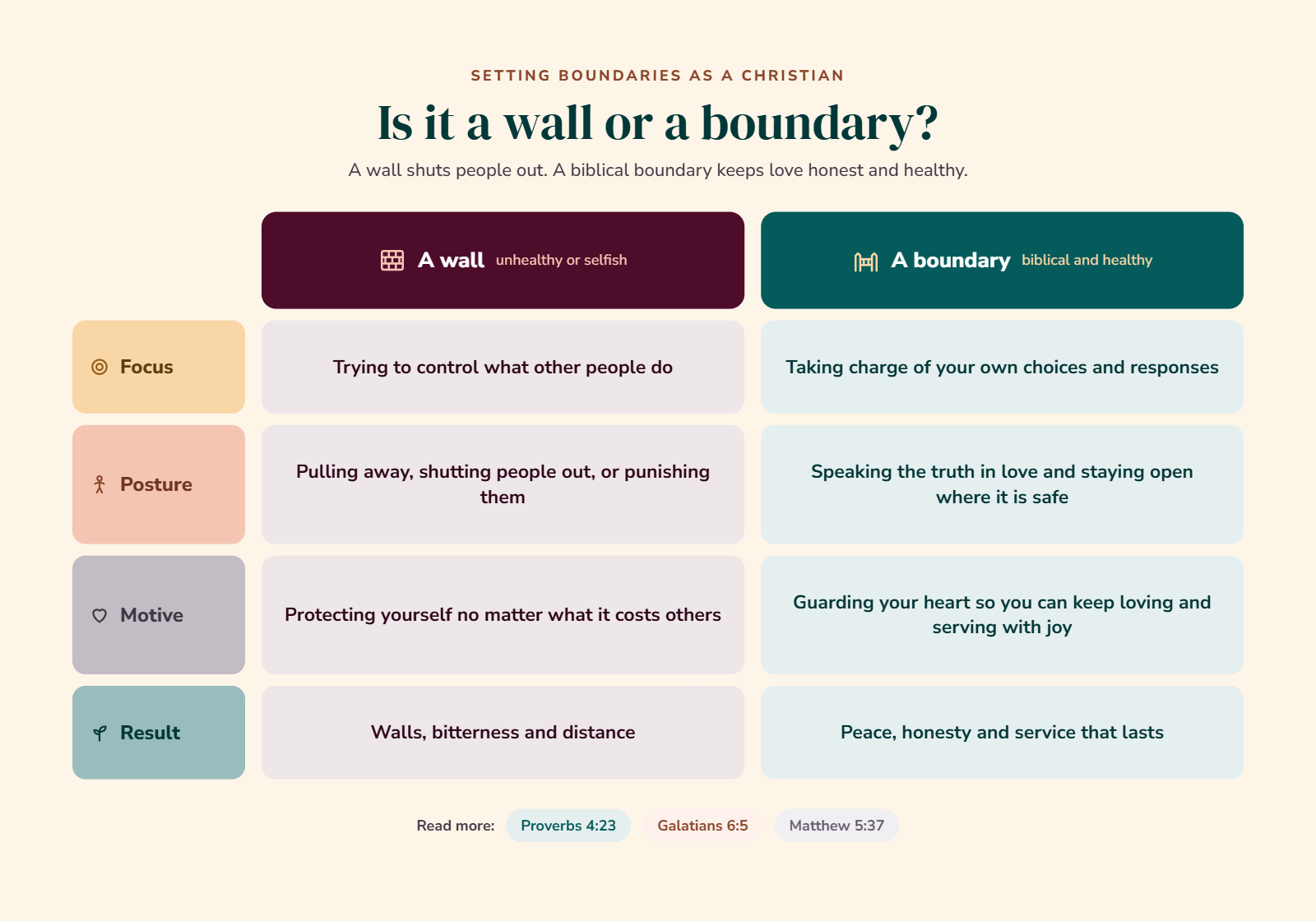
The difference is not whether you say no. It is the heart and the method behind it. Jesus summed up the posture in Matthew 5:37: "Let your 'Yes' be 'Yes,' and your 'No,' 'No'. Clear, honest, and kind.
Jesus Set Boundaries Too: 3 Examples from the Gospels

If anyone had the right to say yes to every need, it was Jesus. Yet the Gospels show Him choosing limits again and again, without ever sinning or failing to love.
Jesus Withdrew for Rest and Prayer
Luke 5:15-16 tells us that large crowds gathered to hear Jesus and be healed, "but Jesus often withdrew to lonely places and prayed" . Read that again. The needs were real, and the crowds were still there. But he walked away anyway.
Mark 1:35-38 goes further. After a long night of ministry, Jesus rose early to pray alone. When the disciples found Him and said, "Everyone is looking for you!" He did not rush back to meet the demand. He said it was time to move on to other towns, because that was His purpose. Jesus let His Father, not the crowd's urgency, set His agenda.
There is a health lesson here too. Rest is not a reward for finishing everything; it is part of how we are designed. Burnout is a syndrome from chronic stress that has not been successfully managed, marked by exhaustion, mental distance from one's work, and reduced effectiveness. Taking on too much and lacking boundaries can contribute to it.
Jesus Refused Unreasonable Demands and Entrapment
John 2:24 says Jesus "would not entrust himself to them, for he knew all people".
He loved people deeply and still did not hand over access to everyone who praised Him.
In Matthew 12:46-50, His mother and brothers waited outside wanting to speak to Him while He was teaching. Jesus used the moment to say that those who do the will of His Father are His true family. He was not dishonouring His mother; He was refusing to let even good, family-shaped demands pull Him off His mission.
(Remember that He also tenderly provided for Mary from the cross in John 19:26-27. Boundaries and honour can live together.)
Jesus Maintained Circles of Intimacy
Jesus loved everyone, but He did not give everyone the same access.
The crowds heard Him teach and received healing.
The seventy-two were sent out in ministry (Luke 10:1).
The Twelve walked closely with Him (Luke 6:13).
Peter, James, and John were brought into the most private moments, such as the raising of Jairus's daughter and the Transfiguration (Mark 5:37; Mark 9:2).
This is not favouritism or coldness. It is wisdom. Love is for everyone, but access, trust, and vulnerability are given in proportion to wisdom and trustworthiness.
You can love the whole church and still not tell everyone your private struggles.
How to Set Boundaries as a Christian Without Feeling Guilty

Knowing boundaries are biblical is one thing. Living them out is another. Here is a simple, prayerful way to start.
Step 1: Identify Your Limits Before Saying Yes
You cannot protect what you have not named. Pause and ask honestly about your limits in four areas: emotional (how much can I carry right now?), time (what is my schedule actually able to hold?), financial (what can I give without hardship?), and physical (am I sleeping, eating, and resting enough?).
Watch for the red flags: lingering resentment, chronic tiredness, dread when your phone rings, and a sense of being used. These are not signs of a bad Christian. They are signals worth listening to.
Even Moses needed this lesson. When he tried to judge every dispute alone, his father-in-law Jethro warned him, "What you are doing is not good. You and these people who come to you will only wear yourselves out" (Exodus 18:17-18, ), and encouraged him to share the load.
Step 2: Communicate Your Boundaries with Love and Clarity
Once you know your limit, say it simply. Long, defensive explanations often invite negotiation and feed guilt. A kind, short answer is usually enough. As Colossians 4:6 says, let your speech be "always full of grace, seasoned with salt" .
Here are sample scripts you can follow;
Script: a church or ministry request "I am so grateful for this ministry, but my current commitments do not allow me to serve in this capacity right now."
Script: respect in conversations "I value our relationship, but I need us to speak respectfully to each other if we are going to continue this conversation."
Script: a late-night or repeated request "I care about you, but I am not able to talk tonight. Can we speak tomorrow afternoon?"
Step 3: Pray, Reflect, and Differentiate True vs. False Guilt
Boundary guilt is often a mix of two very different things.
True conviction is the Holy Spirit pointing to actual sin, such as selfishness, deceit, or neglecting someone who truly depends on you.
It is specific, it leads toward repentance, and it brings hope. Paul describes this in 2 Corinthians 7:10: godly sorrow leads to repentance, while worldly sorrow leads to death.
False guilt is the fear of disappointing people, of being misunderstood, or of being seen as "not spiritual enough." It tends to be vague, heavy, and driven by other people's opinions. Paul puts it bluntly in Galatians 1:10: "Am I now trying to win the approval of human beings, or of God?".
When guilt arises, try asking: Lord, is this You convicting me, or is this fear of people? Have I done something that needs to be made right? If it is conviction, repent and adjust. If it is false guilt, you can hold your boundary with a clear conscience and a prayerful heart. Over time, consistency makes the guilt quieter.
Biblical Boundaries in Family and Friendships

Setting Boundaries with Family Without Abandoning Love
Family is where boundaries often feel hardest, especially in cultures where honour for parents and elders is deeply valued (and rightly so). Exodus 20:12 commands us to honour our father and mother. But honour is not the same as obeying every demand, and it does not cancel adult responsibility. Genesis 2:24 describes a person leaving their father and mother to form a new household, a principle of healthy separation.
In practice, honouring your parents and in-laws can still look like a respectful "no":
Intrusive questions (about marriage, children, income): "I know you care about me. I'm not ready to talk about that, but I would love to hear how you are doing."
Financial pressure: "I want to help where I can, and this is what I am able to give."
Disrespectful habits: "I'm happy to visit, but I will step out if we start shouting."
Christian Boundaries in Dating and Friendships

In dating, boundaries protect physical, emotional, and spiritual purity and clarity. That may include agreeing on physical limits, not sharing your deepest emotional life before commitment, and not being pulled into spiritual compromise. Paul urges believers in 1 Thessalonians 4:3-7 to live in holiness and honour. Proverbs 22:3 reminds us that the prudent see danger and take refuge.
In friendships, boundaries mean mutual respect. Healthy friends do not guilt you for saying no, and you do not use friends only as a convenience. Proverbs 27:6 says that wounds from a friend can be trusted, which means truth spoken kindly strengthens friendship.
Handling Severe Disrespect and Harmful Behavior
This part matters: Christian love does not require you to stay in harm's way. Enduring abuse, whether physical, emotional, verbal, or sexual, is not a sign of spiritual maturity, and the Bible never commands it. Proverbs 22:3 again applies, and Jesus Himself walked away from those who sought to harm Him (Luke 4:28-30).
If someone is repeatedly harming you, disrespecting you, or threatening your safety, remember:
Safety comes first. It is wise and godly to create distance.
Enabling harmful behaviour is not kindness.
Seek help from a trusted pastor, counsellor, or healthcare professional, ideally someone trained in abuse and trauma.
If you are in danger, contact the local emergency services, close to you.
Boundaries and Forgiveness in the Bible: Can You Forgive and Still Say No?

Forgiveness Does Not Automatically Restore Access
Many Christians hold back from boundaries because they think forgiveness means going back to how things were. Scripture helps us separate three things:
Forgiveness is releasing the debt, a decision you make even if the other person never apologises. "Be kind and compassionate to one another, forgiving each other, just as in Christ God forgave you" (Ephesians 4:32)
Reconciliation requires two people: honesty, repentance, and change. Jesus describes a process for conflict in Matthew 18:15-17 that involves truth-telling, not pretending.
Trust is rebuilt slowly, through consistent, proven behaviour over time. God forgives instantly, but He does not hand sensitive responsibilities to people who have not shown they can carry them.
So yes, you can forgive someone fully and still decline to give them the same access you once did.
What Does Guarding Your Heart Mean Biblically?
Proverbs 4:23 is not about building a wall. The Hebrew idea of the "heart" includes your thoughts, desires, and will, so guarding it means being thoughtful about what you let shape you, including relationships, media, and influences.
Romans 12:18 balances this nicely: "If it is possible, as far as it depends on you, live at peace with everyone".
Notice the phrases if it is possible and as far as it depends on you. You are responsible for your part, but you cannot control another person's response. Peace is the goal, but it does not require you to say yes to everything.
The Henry Cloud Boundary Framework: A Biblical Evaluation
This blog won't be complete without the well-known book Boundaries: When to Say Yes, How to Say No to Take Control of Your Life by Dr. Henry Cloud and Dr. John Townsend.
Their central idea is simple but powerful: we are responsible to others, not for others. We can love, encourage, and support, but we cannot live other people's lives for them, and we should not let them live ours.
This lines up neatly with Galatians 6:2 and 6:5, which we looked at earlier.
Applying Practical Wisdom Alongside Scripture
As with any Christian self-help resource, the best approach is to read it with your Bible open. Cloud and Townsend ground many of their ideas in Scripture, and their framework can be a helpful tool. But Scripture remains the final authority, and no book replaces prayer, wise counsel, and the leading of the Holy Spirit. Think of psychological insight as a servant of wisdom, not a replacement for it.
Wrap up: You Can Love People Without Saying Yes to Everything

Setting healthy boundaries as a Christian is an act of wisdom. It protects your peace, prevents resentment, keeps your service joyful, and honours the God who gave you a limited body, a finite day, and a heart worth guarding. Jesus rested, withdrew, said no, and still loved perfectly. You are allowed to follow His example.
Frequently Asked Questions
Is it selfish to set boundaries as a Christian? No. Selfishness ignores others to protect comfort. Biblical boundaries manage your own choices, speak truth in love, and protect your ability to serve.
What does the Bible say about boundaries? Though the word is modern, Scripture teaches ownership of your own load (Galatians 6:5), guarding your heart (Proverbs 4:23), clear speech (Matthew 5:37), and peace as far as it depends on you (Romans 12:18).
Did Jesus set boundaries? Yes. He withdrew to pray (Luke 5:15-16), did not entrust Himself to everyone (John 2:24), and kept different circles of closeness.
Can I forgive someone and still keep a boundary? Yes. Forgiveness releases the debt; reconciliation requires repentance; trust is rebuilt over time.
How do I say no without guilt? Identify your limit, say it kindly and briefly, and ask God whether the guilt is conviction or fear of people.
